Showing posts with label Cricklewood. Show all posts

Anniversary 1896

On October 31, 1896 The Middlesex Courier reported
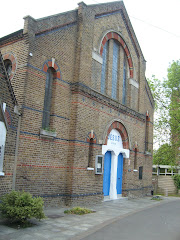
Baptist Chapel.—The anniversary of this church was held on Sunday last, when appropriate sermons were preached by the pastor, the Rev. J. Sylvester Poulton, to good congregations both morning and evening. On Tuesday a public tea was held in the British School, when the prettily-arranged tables were well filled with provisions and guests. The evening public meeting was held in the chapel, which had been tastefully decorated for the occasion. Mr. Herbert Marnham (of Hampstead) took the chair and was supported by the Rev. W. Brock (of Heath Street, Hampstead), Rev. H. B. Murray (of Canterbury Road, Kilburn), and the pastor. A letter was read from the Rev. W. Whittley. (of the Lown Memorial Church, Cricklewood*) expressive of his regret at being absent, which had been occasioned by the sudden and serious illness of a relative. The meeting was a very hearty one throughout, suitable and stirring addresses being given by all the speakers. The report, which was read by the secretary (Mr. J. Moore), showed that a quiet, steady work was being done by the church, and that a decided progress had been made in all the organisations. The pastor expressed the thanks of the church and congregation to the speakers, and to all those friends who by their offerings of money and service had contributed to the success of the anniversary.

*This is the church that began in 1885 as an iron mission chapel in Cricklewood Lane, an outreach of Lyndhurst Rd, Hampstead church 1885. The congregation moved the other side of Cricklewood Broadway to ao brick building, Lown memorial hall in Howard Rd, in 1893. A new chapel in the Gothic style with a tower was opened 1902 in Chichele Rd. In 1903 the attendance was 187 am and 402 pm. By 1978 it had only 21 members and closed. It reopened as a mosque in 1980. 

Snippet 12 Background

In 1593 the name ‘Childes Hill’ appears on a map of Middlesex (John Nordon’s). A Tudor hamlet behind the present ‘Castle’ public house was a flourishing centre for pottery and tiles, using local yellow and blue clay. By the mid-19th Century Childs Hill was famous for its laundresses, especially in The Mead. They made good use of the streams flowing from the Heath and the exposed fields for drying the clothes. Clothes washed in London were thought to be susceptible to water-borne diseases, such as cholera and typhoid, and Childs Hill, then still in the countryside was thought ideal.
It was really the opening of the Finchley Road (1826-1829), with a tollgate at the Castle, that started the growth of the community. In the early 1850s a Colonel Evans built houses in a field called The Mead (later renamed Granville Road). In 1868 the Midland Railway came to Cricklewood (originally the station was called Childs Hill Station). In 1884 the Pyramid Light Works, a candle factory, was established, the first factory in the Hendon area.
Housing in Child’s Hill in the 1903 was described as a 'disgrace to civilisation' and in 1914 Hendon Urban District Council built its first council estate, with 50 houses. In 1901 the land between Childs Hill and Golders Green to the north was still farmland, but with the motorised buses (1906), the tube at Golders Green (1907), the trams (1909) and finally the Hendon Way (1927) farmland succumbed to suburbia. For entertainment Childs Hill had The Regal in the Finchley Road (1929), which was first a skating rink then a cinema then a bowling alley. In the early 1960s many of the small Victorian houses in the Mead and around the Castle Inn were demolished and three high rise blocks of flats built.
Both All Saints Parish Church (the third church in the parish of Hendon) and our own church began their meetings in local laundries before the present buildings were erected in 1856 and 1870 respectively. Further extensions were added to All Saints 1878-84. In 1940 the church was so badly damaged by fire that it was substantially rebuilt in 1952.
Evidently both churches were strongly evangelical at first. (The second vicar of All Saints, Rev William H Perkins was a signatory to the Address to the Prelates against the eastward position and vestments.) Sadly, during the time of Rev W D Petter (1893-1933) there was a change to a more Catholic position and this has apparently been the situation over since. Why Mr Petter should have moved from an evangelical position to a more Roman one, we do not know. We ought to give thanks to God that though things have not always been as one would wish with us, a broadly evangelical basis has been maintained. If we think we are standing, let us take heed that we do not fall. How easy it is to begin well but drift.