Showing posts with label Prehistory. Show all posts

The first Baptists in Childs Hill

There were nonconformists in the Childs Hill area perhaps from the earliest times. The house of a Samuel Everard in Childs Hill, it seems, was used for such worship as far back as 1672.
Also
Baptists used a house at Childs Hill in 1823, registered a house at the Burroughs in 1831, and built a small chapel in Brent Street in 1832. After 1843 the chapel served as a warehouse until it was taken over in 1845 by the Shouldham Street Baptist Chapel, St Marylebone, which shared it with Congregationalists. In 1851 there were 30 worshippers but attendance dwindled after the opening of Hendon Congregational church and in 1857 services ceased. Another Baptist church, founded at the Hyde in 1843, had closed by 1857.
 
From: 'Hendon: Protestant nonconformity', A History of the County of Middlesex: Volume 5: Hendon, Kingsbury, Great Stanmore, Little Stanmore, Edmonton Enfield, Monken Hadley, South Mimms, Tottenham (1976), pp. 39-43. URL: http://www.british-history.ac.uk/report.aspx?compid=26889 Date accessed: 19 May 2011.

Old Childs Hill

This is a copy of an (idealised?) Childs Hill scene from the 18th Century

Snippet 11 Prehistory

The district now known as Childs Hill formed part of the ancient Manor of Hendon with which St Dunstan, Archbishop of Canterbury (d 988), endowed the Abbey of St Peter at Westminster in 959. In 1150 Abbot Gervase de Blois (illegitimate son of King Stephen) gave the land away. By 1295 the land was in royal hands again until Edward I gave it to Westminster Abbey as soul alms for his dead queen, Eleanor. In 1316 the Abbey exchanged the land for the Manor of Hodford and later in the same century Sir Richard le Scrope, 1st Baron Scrope of Bolton, some time Lord Chancellor, held them before exchanging them with Richard II for lands in Yorkshire. Hodford and Cowhouse were again ceded to Westminster Abbey in soul alms for Richard and his first wife Anne of Bohemia, in 1399. At the dissolution of the monasteries in 1550 the property came to the shortly-lived Bishopric of Westminster and from there into the hands of the Ecclesiastical Commissioners via the Dean and Chapter of Westminster.
Two other dates worth mentioning are 1301 when Richard de Gravesend (Bishop of London) granted Walter de Wenlock (Abbot of Westminster) licence to celebrate ‘Divine service’ in the chapel which the monks of Westminster had built on their Manor of Hodford, provided that the consent of the Rector of Hendon be first obtained.
Then in 1321 The Black Book of Hendon included the name of Richard Child. It is from the Child family that Childs Hill derives its name.
Thus from quite early times Childs Hill was subject to the attentions of professing Christians. Sadly the state of the Mediaeval church was such that one wonders if any peasants in the area would have heard the gospel from the monks. We do not know, but God knows and one day in Heaven may be we will find that even in ancient times God had a people in this same area.

More Background

Childs Hill. A district on both sides of the Hendon-Hampstead border, Childs Hill took its name from Richard le Child, who in 1312 held a customary house and 30 acres, probably on the Hendon side. A similar estate was held at the same time by Richard Blakett, who gave his name to Blacketts well, which in 1632 was one of the boundary markers in the area and in 1801-2 was disputed in ownership.
By the mid 18th century the Hampstead part of Childs Hill was divided in two by the road later called Platt's Lane, which ran from West End and Fortune Green to the heath, Hampstead town, and Hendon. It was entirely occupied by two estates, both of which may have originated as land of the Templars. A farmhouse on the edge of the heath in the north part of the larger estate had apparently become detached from the farmland before 1811, when it was enlarged by Thomas Platt as a 'pleasing and unostentatious' brick house set in well wooded grounds.
The arrival of the Finchley road lessened the area's isolation. A house called Temple Park was built on the smaller Temples estate probably in the 1830s by Henry Weech Burgess, a prosperous Lancastrian. About the same time farm buildings were erected on Platt's estate fronting Platt's Lane. In 1843, on the western portion of Childs Hill estate, T. Howard built Kidderpore Hall, a stuccoed Greek revival house with a slightly projecting colonnade, side pediments, and a semicircular bay, for John Teil, an East India merchant with tanneries in the district of Calcutta from which the house took its name. The grounds became a private park and two lodges were added, one on the Finchley road in 1849, the other on Platt's Lane in the late 1860s. On a field of Platt's estate which jutted westward south of Teil's estate, four houses fronting Finchley Road were built in the 1840s in the district called New West End.
By 1870 the farm buildings at Platt's Lane had been replaced by a house. Two cottages were built in Platt's Lane by P. Bell of West End in 1875 and 13 houses, mostly by George Pritchard, between 1884 and 1886.
From: 'Hampstead: Childs Hill', A History of the County of Middlesex: Volume 9: Hampstead, Paddington (1989), pp. 73-5. URL: here

Constable Painting

The famous artist John Constable lived in the Hampstead area near Childs Hill. This painting depicts Childs Hill as it may have been then with Harrow in the distance. The painting was sold at Sotheby's in 1989 and appears to be in private hands.

Background Material

The following info is found here on a Barnet local government site
The settlement at Childs Hill is certainly medieval, possibly the 10th century settlement Codenhleawe and later called "Cowhouse". Although a John Knot de Childes Hill is associated with the Peasants' Revolt (1381), the earliest known use of the place name Child's Hill is in 1593. The name is probably taken from a family called Child in the 14th century. The Castle Inn was first recorded in 1751, when Child's Hill was a centre for brick and tile making during the second half of the 18th century, supplying material for building Hampstead, and run by the Morris family.
Being more than 259 feet above sea level (at the Castle Inn), Child's Hill is visible for miles around. From 1808 to 1847 there was anoptical telegraph station, one in a line from the Admiralty to Great Yarmouth. Only the name, Telegraph Hill, remains.
An Act of Parliament in 1826 allowed for the construction of the Finchley Road (completed by 1829) with a tollgate at the Castle Inn. In the early 1850s a Colonel Evans built houses in a field called The Mead, where the Morris brick works had been. The road was later called Granville Road.* In 1856 a new church, All Saints', was built. In 1940 the church was so badly damaged by fire that it had to be substantially rebuilt in 1952.
By the 1870s a number of laundries Childs Hill cleaned clothes for people in the new suburbs of West London and Hampstead. Clothes washed in London were thought to be susceptible to waterborne disease, such as cholera and typhoid, and Childs Hill, then still in the countryside, was supplied by a series of small streams coming off Hampstead Heath. In 1884 the Pyramid Light Works, a candle factory, was the first factory in the Hendon area. Victorian Childs Hill was a "very low" place, with cock-fighting, drunkenness, vice, and housing in Child's Hill in the 1903 was described as a "disgrace to civilisation" and in 1914 Hendon Urban District Council built its first council estate, with 50 houses.
With the motorbuses (1906), the tube at Golders Green tube station (1907), the trams (1909), and finally The Hendon Way (1927) farmland succumbed to suburbia. For entertainment Childs Hill had The Regal in the Finchley Road (1929), which was first a skating rink then a cinema then a bowling alley. In the early 1960s many of the small Victorian houses in the Mead and around the Castle Inn were demolished.
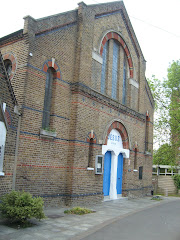
* The chapel is here (now in Mortimer Close). It was built in 1870.