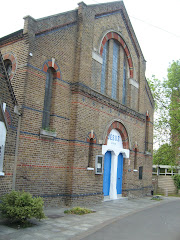
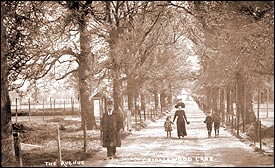
 This is the final part of the Wardley article from the same source as the previous two. Nothing about the chapel as such.[Pic: The Avenue Cricklewod Lane]
When Mother was a girl she said she seldom had meat to eat. We had it once week - a glorious sirloin of beef, hot on Saturday, cold on Sunday, made into shepherd's pie on Monday. For Sunday breakfast we had Dad's home made sausages, the most delicious things you can imagine.
Grandfather was a preacher in the 7th London Circuit of the United Methodist Free Churches. We have a photo of him with 28 other worthies. His heart was in his preaching and not in business, and he liked nothing better than travelling on horseback to preach.
When he died in 1899 he left Father with debts. The folk in the large houses thought nothing of running up large bills, and not paying them. Costers in the cottages were cute, sending their children to buy one ha'porth of pickle in paper or a ha'porth of jam, and the scales in those days did not balance but must go down.
I remember when Princess Christiana (of Schleswig Holstein, sister of the Princess of Wales, who was later Queen Alexandra) came to open the newly built Institute (June 30, 1896). Dad made an archway of greenery from Granville House to our Corn Shop (what was the Men's Institute in Cricklewood Lane is now Childs Hill Library).
I remember going in the wagonette to take Grandma and Grandpa to the Wesleyan Church opposite Willoughby Road. We went along the Finchley Road, up Frognal and through to Church Row, where we had to pay at a tollgate. We walked over the West Heath three times on a Sunday to go to Heath Street Baptist Church and Sunday School. As we walked up from The Castle to the top of the Sandy Gallop the fields belonging to Mr Rickett of Sunnyfield were on our left. (Mr RIckett was a JP and a benefactor of the churhc in the early days). The Hermitage (pulled down in 1974) was on our right, followed by the horses' drinking trough (very much needed, specially on the nights before Bank Holidays when the fair people with their caravans and swings and roundabouts moved slowly up the hill) and Telegraph Hill on which was Miss Schroeder's cottage. My eldest sister had an allotment on the top of that hill, where the artist Sir Frank Salisbury later built Sarum Chase.
Grandpa died in 1899, aged 80, and Grandma in 1904, aged 92. Our family consisted then of Gordon 3, Winifred 5, Bernard 9, (darling twins had died in between), Alfred 12. I was 15, Alice 17, Grace 20. Winifred remembers walking with Gordon down Cricklewood Lane to a private school in Elm Grove called Sparkbrook College. A sweet shop opposite The Tavern sold "wiggy waggy toffee" at 8 oz a penny. You could get a good-sized bag of the black wafery stuff for a farthing. Further down, on the left, was the Home of Rest for Horses.
In 1908 the trams came down to Cricklewood, and Granville House was pulled down to widen the Lane into a road. Trams with open wooden-lath seats and open tops ran down the Lane. Later they went all the way to Barnet. Horse buses went along Finchley Road from The Castle, all the way to Oxford Street for 4d. In 1974 the shops opposite Granville House were pulled down. Our house and garden at Ridge Road is now part of the site of two rows of maisonettes with a road in between. Our house and long garden next to the Hermitage, where we lived after Ridge Road, is now the site of a large block of greyish Council buildings. But I still see things as they were.