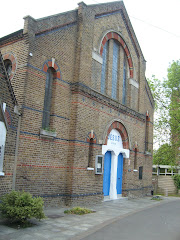
The Church Minute book lists the first deacons as
G Rudd
T Elphick
R Keevil (Treasurer)
D James
W J Sims
Jos Smith
Jos Turvie was also appointed as Financial Secretary (a sort of deputy treasurer)

Baptists in London in the 19th century
The nineteenth century saw a gradual coming together of Connexion and Particular Baptists. In 1812-
13 a Baptist Union was formed, and while largely influence by Particular Baptists, over time it began
to draw in churches from the Connexion. By the end of the century this was the main body
representing Baptist churches. Yet there was also division – some felt that Calvinistic doctrinal
standards were slipping. In the early nineteenth century, a group of churches, influenced in part by
London Baptist minister John Stevens, emerged as the Strict Baptists. The first Strict Baptist
periodical, the Gospel Standard, was published in 1835. A Metropolitan Association of Strict Baptist
Churches was formed in 1871.
As London experienced rapid expansion there was a flourishing of Baptist church building. This was
fuelled in part by the formation in 1865 of the London Baptist Association, which ten years later had
131 members. One of the main aims of the organisation was the provision of funds for church
extension (now commonly known as ‘planting’). In the first years of the Association, funds were found
to build Baptist churches in Upper Holloway, Victoria Park, The Downs (Clapton), Battersea Park,
Surbiton, Balham, Leyton and Highgate Rd. These years of church building reflected the growing
confidence of the Baptist community: many of these churches were spacious, seating numbers from
350 to 1000, and they were built on prominent sites, often on main roads.
The Daily News census of religious worship in 1902-3 indicated that Baptists, with 163,052
worshippers, were the largest of the Free Church denominations. Attendance at the best-attended
Baptist churches showed that certain preachers could still draw crowds. The largest attendance at
one Baptist service was 2,210, at the huge Metropolitan Tabernacle, founded at the Elephant and
Castle by the Victorian ‘prince of preachers’, C.H. Spurgeon. The next largest Baptist causes - with
more than 1,000 people at one service - were the East London Tabernacle, founded and built up by
Archibald Brown, a friend of Spurgeon’s, followed by Tabernacles or Chapels at Woolwich,
Westbourne Park, Poplar, Shoreditch, Upper Holloway, Ferme Park, West Norwood, West Croydon
and Peckham. Many had been planted by students from Spurgeon’s College, an institution for
training Baptists ministers in London.*
An important gauge of Baptist social involvement is the activity of Baptist churches in deprived areas.
Here the work of Baptist deaconesses was crucial. In 1890 a Baptist Deaconesses’ Home and Mission
had been founded under the direction of F.B. Meyer and the London Baptist Association, and medical,
social and evangelistic work was undertaken. With the support of the Deaconesses, many Baptist
churches were active in social engagement.
* The second minister at Childs Hill was from Spurgeon's College. Seating at the chapel was said to be 400.

Covenant Card


Not sure when this dates from (1930s or 1940s) or how old the wording is. Interesting though.
Chapel Exterior c 1970

This exterior side shot is probably from around 1970 too. Not much has changed
Chapel Interior c 1970

This picture must have been taken in the early seventies (or perhaps late sixties) when the chapel was in a state of disrepair and the meetings took place in the hall next door.
William Rickard's roots
A now removed entry about Weston Mill in Pennycross, Devon, said that
At the time of the census in 1851, 33-years-old Mr
James Boon was the corn miller, employing nine men. His wife, Maria, was 38 and
they had a two-years-old son, William, who was born at Pennycross. In addition
to a visitor from London, there were two manservant cum labourers, Richard and
John Wills, aged 15 and 17 respectively, and two female house servants, Miss
Susan Pascoe, 20, and Miss Eliza Knight, 16.
Possibly one of the millers that James employed was
a Mr William Rickard, the 14-years-old son of farm labourer, Mr Thomas Rickard (born 1792),
who lived nearby.
Subscribe to:
Posts (Atom)