William Rickard's roots

This entry here about Weston Mill in Pennycross, Devon, says that
At the time of the census in 1851, 33-years-old Mr James Boon was the corn miller, employing nine men. His wife, Maria, was 38 and they had a two-years-old son, William, who was born at Pennycross. In addition to a visitor from London, there were two manservant cum labourers, Richard and John Wills, aged 15 and 17 respectively, and two female house servants, Miss Susan Pascoe, 20, and Miss Eliza Knight, 16.
Possibly one of the millers that James employed was a Mr William Rickard, the 14-years-old son of farm labourer, Mr Thomas Rickard, who lived nearby.

History of Middlesex Volume 5 Baptist Entry

Under the heading "Baptists" in 'Hendon: Protestant nonconformity', A History of the County of Middlesex: Volume 5: Hendon, Kingsbury, Great Stanmore, Little Stanmore, Edmonton Enfield, Monken Hadley, South Mimms, Tottenham (1976), pp. 39-43. URL: http://www.british-history.ac.uk/report.aspx?compid=26889 we read

Hendon Baptist church was formed in 1873 by a group led by E J Smart, a Brent Street ironmonger, which had been meeting since c 1869 in the former Hendon charity school in Church Road. In 1878 the congregation moved to an iron hall in Finchley Lane, built by Stephen Shirley as a temperance hall. A permanent church, seating 600, was opened in 1886 on a sloping site 80 yards to the west. It was designed by J E Sears in an individualistic version of 13th-century Gothic, and is an aisled cruciform building, whose crypt serves as a church hall.

West Hendon Baptist church arose from a Sunday school which was meeting in private premises in Pollard Road in 1884. Through the efforts of E. J. Smart, a mission hall, used also as a day school, was built in Edgware Road in 1885; the building survived behind a shop in 1970. Members began meeting in new premises on the corner of Wilberforce and Station roads in 1898 and shared a minister with Hendon Baptist church until 1901. A church of brick and pebble-dash was built in 1930. It had seating for 250 in 1970, when the old church was used as a hall.

Childs Hill Baptist chapel originated in open-air meetings which were held in a cock-pit at the Old Mead in 1865 and were transferred to a laundry in Granville Road in 1866, shortly before the foundation of the chapel. In 1875 new premises in Granville Road, erected at the expense of Heath Street church, Hampstead, were registered for worship (GRO registration number 22498 in line with the 1855 Places of Worship Registration Act). The church was built of brick in a partially Byzantine style and a hall of similar design was added later. The seating capacity was 400 in 1972.

Claremont Baptist Free church originated in a mission started by Childs Hill Baptists in Claremont Road, Cricklewood, by 1928. A separate church was formed in 1931, when brick premises, registered in 1935, were erected between Claremont Road and Cheviot Gardens. A brick hall was added in 1958. There was seating for 350 worshippers in 1972.

Tennyson Road mission arose from a Baptist group which was flourishing at Mill Hill in 1881. A chapel was built in Tennyson Road between 1894 and 1896 but by 1906 had been leased to the Brethren. In 1908 the building became the first meeting-place of Union Congregational church.

The entry under "Strict Baptists" reads:

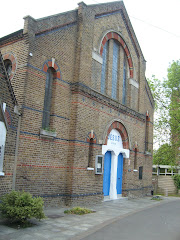
In 1938 a long-established chapel in Christchurch Passage, Hampstead, was compulsorily purchased, whereupon the congregation took over a building in Bridge Lane, Temple Fortune, which was registered as Ebenezer Strict Baptist chapel later that year. In 1972 the congregation was affiliated to the 'Gospel Standard' section of Strict Baptists.

The first Baptists in Childs Hill

There were nonconformists in the Childs Hill area perhaps from the earliest times. The house of a Samuel Everard in Childs Hill, it seems, was used for such worship as far back as 1672.
Also

Baptists used a house at Childs Hill in 1823, registered a house at the Burroughs in 1831, and built a small chapel in Brent Street in 1832. After 1843 the chapel served as a warehouse until it was taken over in 1845 by the Shouldham Street Baptist chapel, St Marylebone, which shared it with Congregationalists. In 1851 there were 30 worshippers but attendance dwindled after the opening of Hendon Congregational church and in 1857 services ceased. Another Baptist church, founded at the Hyde in 1843, had closed by 1857.

From: 'Hendon: Protestant nonconformity', A History of the County of Middlesex: Volume 5: Hendon, Kingsbury, Great Stanmore, Little Stanmore, Edmonton Enfield, Monken Hadley, South Mimms, Tottenham (1976), pp. 39-43. URL: http://www.british-history.ac.uk/report.aspx?compid=26889 Date accessed: 19 May 2011.

John Pretlove

Fiona Pretlove Foster, daughter of former pastor, John Pretlove has been in touch. She pointed out one or two factual errors here that I have endeavoured to correct. She tells us that her dad taught at Criswell College, Dallas, Texas for over 25 years. Her mom passed away in 1996 and her dad has remarried. His second wife's name is Catherine, "who was also a member of his then congregation - a pattern!" comments Fiona. She says that Dr Pretlove is now pastor of a church in Las Vegas, Nevada but comes to England about twice a year as he is on the board of Chosen People Ministries. He has another daughter (Heather) who, like Fiona, was born while at Child's Hill. He also has a son David (born in the USA) who is himself a pastor, in Reno, Nevada. Fiona also adds that John now has five grandchildren. "I still remember living in the manse" she says.

Sunday School Prize 1888

A correspondent in Australia noticed the inscription in a book she found at her grandmother's house. She very kindly tracked me down and sent these pictures. Her grandmother is not Nellie Mole. Nellie Mole, if I am correct, was about 15 in 1888 and lived in 6 Albion Terrace on Childs Hill Lane (later Cricklewood Lane).

Spurgeon on Harvey


I came across this in the April 1883 edition of The Sword and Trowel
It is one of the disadvantages of the early preparation of monthly periodicals that notices must sometimes appear late. Friends must pardon the lateness of an in memoriam note concerning James Harvey Esq, of Hampstead. He was for many years one of the most liberal helpers of the work which the Lord has entrusted to us: and we hear that he has left a legacy of £500 to the Orphanage. We may not mention many of the things which were done of him in secret; but we may say that he was the donor of the house on the boys’ side of the Orphanage, which is known as "the Merchant’s House". This he gave without a request or even a hint from us.
He was a man of mark: independent, yet ready to learn; lenient towards doubt, but himself a firm believer. His views of truth were his own, and would not be parallel in all points with those of anybody else; but we always felt at one with him, and even where we judged him to be mistaken we were glad to love him just as he was. Our personal loss is very heavy, and, hence, we can the more tenderly sympathize with the esteemed mourners who have lost father and brother. We shall not soon look upon his like again. Are there not other merchants who love our Lord, and will be baptized for the dead, filling up the vacancies caused by these many deaths, and taking thought that the cause of Christ shall know no lack? We commend to all our readers an extract from Mr Brock’s admirable sermon - the sermon itself can be had of J. Hewetson, Hampstead: — "While in good health he was exemplary for punctuality at the service of God; and on very rare occasions was he absent from his place. ‘I am come,’ he said to me, the very Thursday evening before his fatal illness, when I expressed surprise at seeing him, ‘because I am able to go to business, and I do not think I ought to be absent from the church meeting.’"

James Harvey 05

In 1855 Harvey's only son was sick and it was thought better air would help. This led eventually to a permanent move to Hampstead in 1861. They began on Haverstock Hill, then, after moving up it once they took up residence in newly built Mount Grove on the then new Greenhill Estate in 1870.
The Baptist James Castleden (1778-1854) had laboured in Hampstead until his death but the only nonconformist chapel at that time appears to have been a high one in both senses - high in its Calvinism and high in its location - at the top of Holly Bush Hill. Harvey resolved, partly as thanks to God for his son's refound health, to build new Baptist chapel but the people of the area were poor and there was no place for it anyway. It was another four years before they obtained the land - used a former fruit and vegetable garden. A committee was formed to plan a building but it was too expensive and so the committee was dissolved. However, at long last, on June 4, 1860 Harvey signed a contract to a build chapel with other buildings at the cost of £4,800. It was not built at his sole cost, others did give, but he was a generous contributor. The Heath Street building opened in July, 1861 (see pic). Harvey became a member there and was generous provider for the work. They called William Brock Junior, the son of Dr Brock, to be their first pastor. Typically, the the intention was that the membership would be "open to all who love our Lord Jesus Christ in truth and sincerity" with true believers being baptised by immersion.
Soon there was also a Devon born assistant minister there called William Rickard. He was instrumental in starting the Baptist work in nearby Childs Hill. Although not constituted as a church until 1877, they were able to put up a building in 1870. The inscription has long disappeared but it was Harvey who laid the foundation stone for the new building on July 28, 1870.
At the end of 1865 the London Baptist Association was formed. Unsurprisingly, Harvey was its first treasurer. He served for 16 years, until 1881. In 1870 he offered to help defray debts of many chapels. The idea was that if they paid one third by the end of 1871 he would give 10% of the remainder. He ended up parting with some £500 by this means.
An example of another cause that he helped was the Shoreditch Tabernacle, where William Cuff ministered, which was developed in the 1880s. The meeting on December 1, 1876 held in Harvey's Hampstead drawing room where it became clear that the new building could be financed was one of great joy to Cuff and the deacon who accompanied him.
Harvey felt a duty, according to his son, to give an example but also tried to conceal much of his giving. In 1867 Harvey's good friend C H Spurgeon wrote asking for contribution to Stockwell Orphanage, a work that had then recently begun. Harvey gave £600 to pay for the second house, which was called The Merchant's House.
A letter of July 16, 1867, acknowledges the gift. “You find it more easy to perform noble actions than I do to thank you for them” wrote Spurgeon. A similar sum was given by Harvey for the girls' orphanage 13 years later.
Another example of his kindness through Spurgeon was the way in the Summer of 1876 he sent him £100 to pass on anonymously to ministers in need of a summer holiday. Spurgeon wrote back, passing on the letters thanking Spurgeon himself and acknowledging where the thanks should have gone. In 1882 a gift for the Baptist work in East India Dock produced very thankful letter.
Harvey was also a great supporter of the Baptist Missionary Society. In 1881 he called on supporters of the mission to make 1882 a year of Jubilee. He urged each one to see himself as “the steward not the irresponsible owner of the manifold gifts of God”.
It was only a sort time into 1893 that, on February 9, after two days' illness he rather suddenly died at home, in his sixty-seventh year.
In his little book on his father and using his favourite turn of phrase Alfred Harvey wrote of his father “Never was there a man more naturally modest and unpretentious than he. His unassuming geniality and consideration for others was the same in whatever company he was ....”. he was a man of buoyant spirits. A writer in the Freeman of February 16, 1883 observed how Harvey “had a rare confidence in his own powers ...” taking up various pursuits, “singing ... preaching to the poor ...” and his apologetics work an mastering them. He was a “keen sportsman” “a jocund traveller”. The writer in the Freeman commented “I cannot conceive of Mr Harvey doing anything by halves”. He was paradoxically “devoid of personal ambition, and yet he was ambitious”. He sought “no satisfaction save success” and never rested on his laurels.